The Volume of an Even Dimensional Ball

What is the volume V(r,d) of a ball of dimension d and radius r ? This ball is the following subset of \mathbb{R}^d :

B(r,d) = \{ (x_{1},..., x_{d}) \in \mathbb{R}^d \ | \ \sum_{i = 1}^{d} x_{i}^2 \leq r^2 \},

and we measure the volume using the standard Euclidean measure.
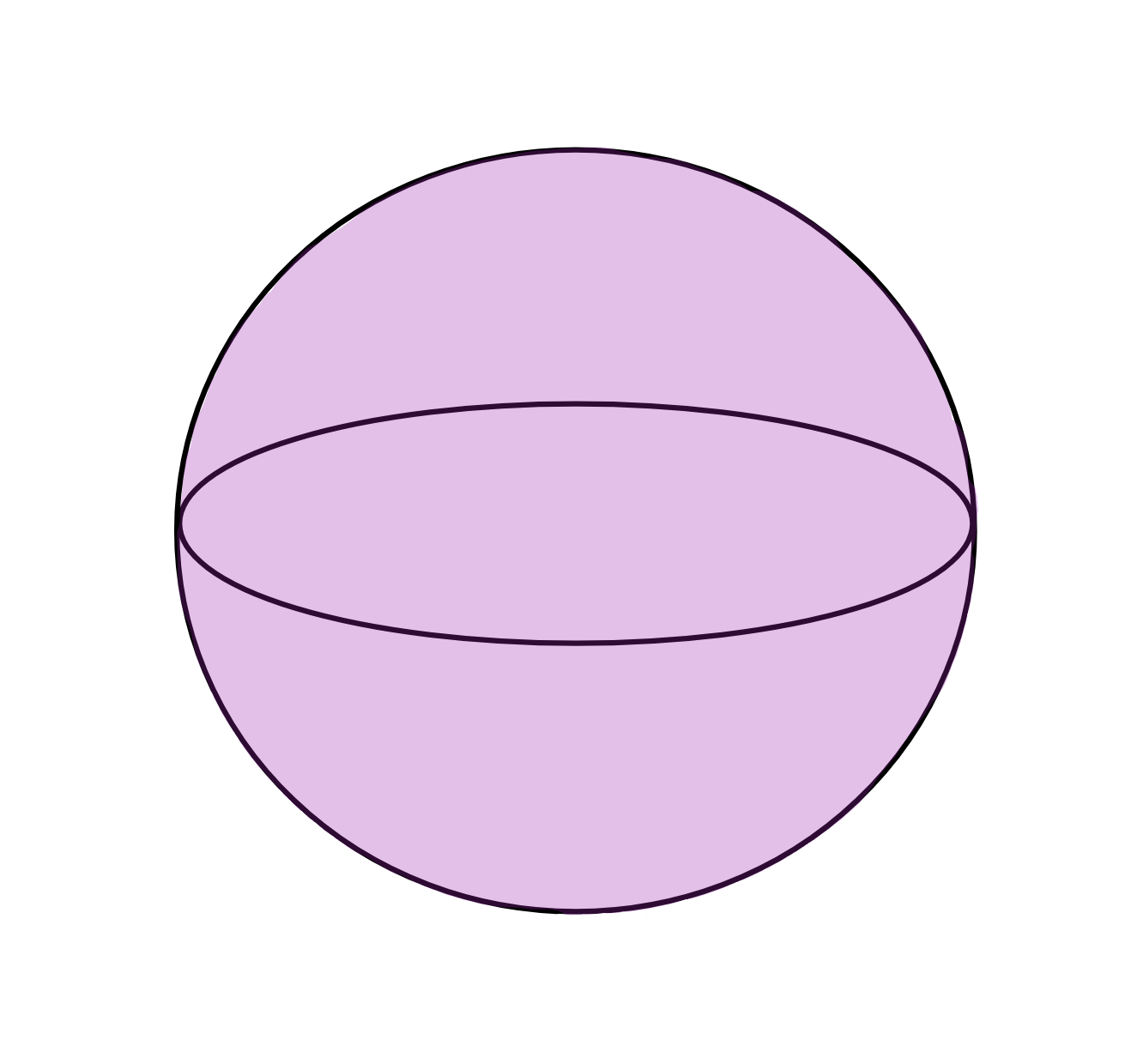
If you only need the answer for even dimensions, here’s an easy way to remember: define V(r) to be the sum of the volumes of balls of radius r over all of the even dimensions:

V(r) = \sum_{n = 0}^{\infty} V(r, 2n) .

Remarkably, the formula for this function turns out to be V(r) = e^{\pi r^2} . This is easy to remember since it’s the exponential of the volume (i.e. the area) of a disc. Then, you can read off the volumes V(r,2n) as the terms in the Taylor expansion of V(r) = e^{\pi r^2} . Explicitly:

V(r,2n) = \frac{\pi^n r^{2n}}{n!}.

A nice, and immediate, corollary is that the derivative of V(r) , with respect to the radius r , gives you the sum of the volumes of all of the odd-dimensional spheres:

2 \pi r e^{\pi r^2} = \sum_{n = 0}^{\infty} Vol(S^{2n + 1}) r^{2n + 1}.

By looking at the coefficients of the Taylor expansion, we can conclude that the volume of the unit sphere of dimension 2n + 1 is \frac{2 \pi^{n+1}}{n!} .

There’s a lot more to say about the volumes of balls and spheres, and if you’re interested, the Wikipedia page is a good place to start.

Okay, but why is the formula for V(r) true? And what’s special about even dimensions? That’s what I want to explain in this post.

Continue reading “The Volume of an Even Dimensional Ball”