What is the volume 


and we measure the volume using the standard Euclidean measure.
If you only need the answer for even dimensions, here’s an easy way to remember: define 

Remarkably, the formula for this function turns out to be 


A nice, and immediate, corollary is that the derivative of

By looking at the coefficients of the Taylor expansion, we can conclude that the volume of the unit sphere of dimension 

There’s a lot more to say about the volumes of balls and spheres, and if you’re interested, the Wikipedia page is a good place to start.
Okay, but why is the formula for
In everything I’ve told you so far, there are really only two key facts from which everything follows. First, there is the formula for the area of a disc 

This says that the volume of a product of 


Computing the Volume of a Simplex
There are different realizations of the simplex, and they don’t all have the same volume. We will need the following version:

Here’s a picture in two dimensions:

In this picture, it’s quite easy to see that the two-dimensional simplex fills out exactly half of the square, and for this reason, its area is 

Here is the argument: a point in the cube ![[0,r]^n](https://s0.wp.com/latex.php?latex=%5B0%2Cr%5D%5En+&bg=%23ffffff&fg=000000&s=0&c=20201002)


![Vol([0,r]^n) = n! Vol(\Delta^n_{r}).](https://s0.wp.com/latex.php?latex=Vol%28%5B0%2Cr%5D%5En%29+%3D+n%21+Vol%28%5CDelta%5En_%7Br%7D%29.+&bg=%23ffffff&fg=000000&s=0&c=20201002)
Just as for balls, we can package the volumes of the simplices of various dimensions into a single function

and from the above calculation, it follows that 
Comparing this volume of a simplex to the volume of an even-dimensional ball, we notice the following analogy:
The simplex 
![[0,1]^n](https://s0.wp.com/latex.php?latex=%5B0%2C1%5D%5En+&bg=%23ffffff&fg=000000&s=0&c=20201002)


At least, this is true when considering volumes. What I want to explain in this post is that this analogy can be made precise. In fact, the volume of the even-dimensional ball can be derived from the volume of a simplex.
Before we continue, a simplification: since the volume of an 


Tropicalization
The key to the comparison between even-dimensional balls and simplices, and the answer to the question ‘why even-dimensional balls?’, is tropicalization, by which I mean the comparison between complex numbers and real numbers given by taking the radius squared:

You should picture this map in the following way:
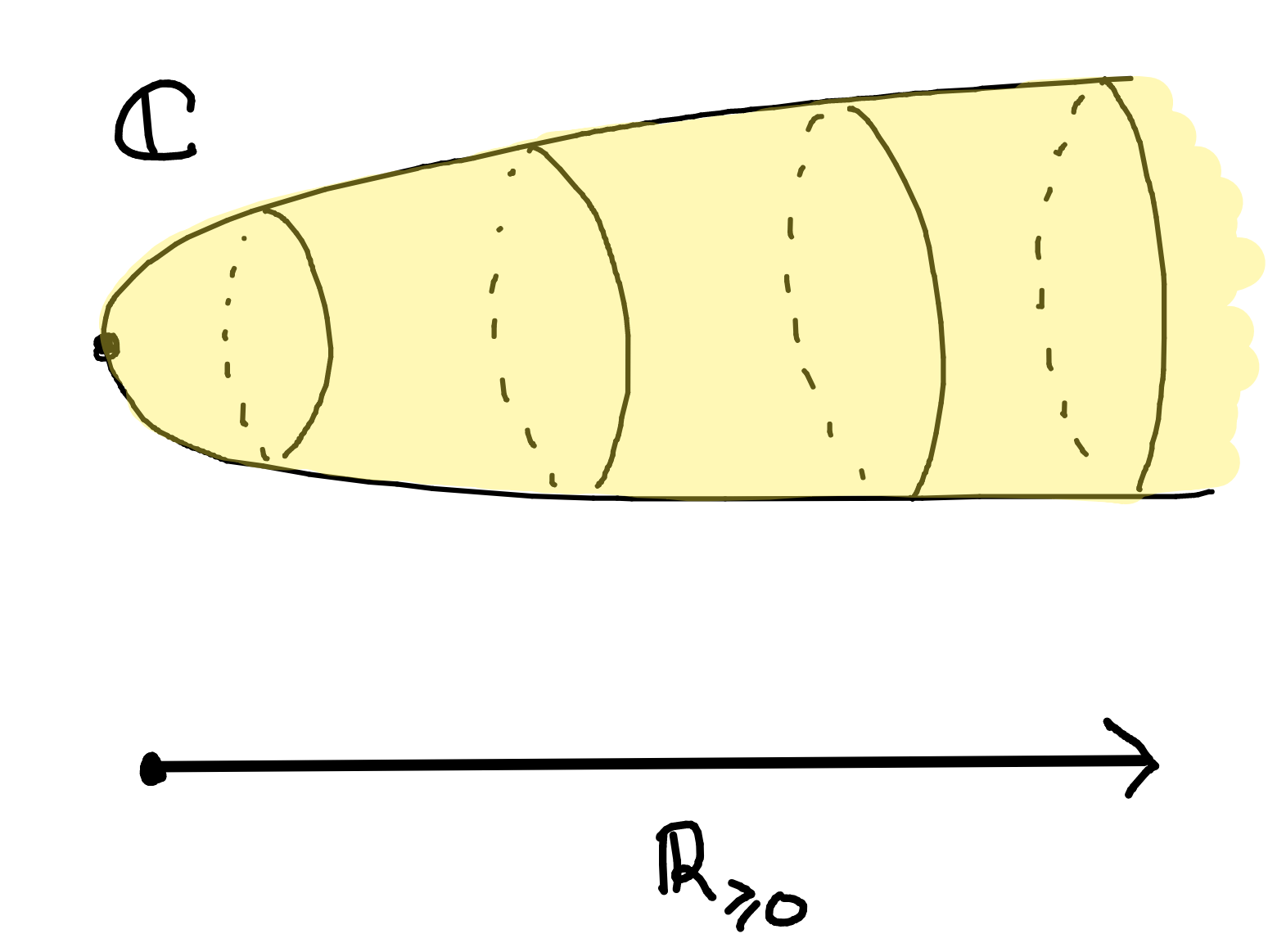
Applying the tropicalization map to various subsets of 

In fact, this is not quite tropicalization. If you look in a paper, such as this one, you see that tropicalization involves taking the logarithm of the radius, 


In any case, the map 


Lemma. The pushforward of the Euclidean volume form 


Indeed, writing the volume form 

and integrating out the angle coordinate 
Given any subset 

where 

Let’s see how this helps. First, the polydisc 

Applying the tropicalization map 
![T(B(2)^n) = [0,1]^n.](https://s0.wp.com/latex.php?latex=T%28B%282%29%5En%29+%3D+%5B0%2C1%5D%5En.+&bg=%23ffffff&fg=000000&s=0&c=20201002)
This implies that the volume of the polydisc is 
On the other hand, the 

and tropicalization gives

This set is a simplex, but it isn’t quite the simplex

You can see that this differs from the earlier picture of a simplex. In fact, the two simplices are related by a simple change of coordinates. Define

for 


whose determinant is easily seen to be 

Combined with the previous facts, we conclude that

We have derived the volume of even-dimensional balls from the volume of simplices!
 Francis Bischoff
One thought on “The Volume of an Even Dimensional Ball”