In this post I will discuss a construction, due to Deligne, for extending a flat vector bundle to a flat logarithmic vector bundle. The setting of the construction is as follows: let  be a smooth complex manifold, and let
  be a divisor (i.e. a codimension 1 subvariety). Then given a branch of the logarithm
  (it is in fact sufficient to choose a ‘set theoretical’ logarithm) Deligne’s construction gives a canonical way of extending a flat holomorphic vector bundle on the complement of
  to a holomorphic vector bundle on
  with a flat logarithmic connection having poles along
  :
:
Theorem. Let  be a holomorphic vector bundle with flat connection on
  . There exists a unique extension
  to all of such that
  has logarithmic singularities along and the eigenvalues of the residue of lie in the image of .
1. Preliminaries on connections.
Throughout let  be a complex manifold, and
  a holomorphic vector bundle.
Definition.
- A connection on
 is a
is a  -linear map
satisfying the Liebniz rule: for every function  and section

- Given a vector field
 , we can hook it into the 1-form part of the connection to get a
  -linear map
  . The connection is flat if for all vector fields
  :
: ![\displaystyle [ \nabla_{V}, \nabla_{U}] = \nabla_{[V,U]}.](https://s0.wp.com/latex.php?latex=%5Cdisplaystyle+%5B+%5Cnabla_%7BV%7D%2C+%5Cnabla_%7BU%7D%5D+%3D+%5Cnabla_%7B%5BV%2CU%5D%7D.+&bg=%23ffffff&fg=000000&s=0&c=20201002)
Remark. By hooking vector fields into the connection, we see that a connection defines an action of the tangent sheaf of on the vector bundle :  . The condition that
  be flat says simply that this is a morphism of sheaves of Lie algebras. In other words, flat connections are representations of the Lie algebroid
  .
.
Locally, we can pick a frame for , allowing us to write a connection as

for a matrix valued 1-form  . More precisely let
  be a local frame. Then
  , for 1-forms
  . Then writing a general section in terms of the frame as a column vector
  we have

where  .
.
It turns out that, despite being defined in terms of a complex structure on and a holomorphic structure on , flat connections are purely topological objects. This is the content of the following theorem:
Theorem. (Riemann-Hilbert Correspondence) There is an equivalence of categories between the category of holomorphic flat connections and the category of finite dimensional representations of the fundamental group of :

The equivalence is given by sending a flat connection to its monodromy representation.
Sketch of Proof. Given a bundle with flat connection  , we use the flat sections (i.e. such that
  ) to identify nearby fibers of . This allows us to define a parallel transport operator
  , which associates a linear isomorphism to each homotopy class of paths:
![\displaystyle [\gamma] \mapsto P_{\gamma} : F_{\gamma(0)} \xrightarrow{\sim} F_{\gamma(1)}.](https://s0.wp.com/latex.php?latex=%5Cdisplaystyle+%5B%5Cgamma%5D+%5Cmapsto+P_%7B%5Cgamma%7D+%3A+F_%7B%5Cgamma%280%29%7D+%5Cxrightarrow%7B%5Csim%7D+F_%7B%5Cgamma%281%29%7D.+&bg=%23ffffff&fg=000000&s=0&c=20201002)
Picking a base-point  and applying the parallel transport operator to the loops based at
  then gives the monodromy representation:

Remark. Using the technology of Lie groupoids, this sketch can be turned into a proof: as argued above, a flat connection is a representation of the tangent algebroid. So, using an analogue of Lie’s second theorem for Lie groupoids/algebroids, it can be integrated to a representation of its source simply connected Lie groupoid, which in this case is the fundamental groupoid of

As it turns out, this representation is nothing but the parallel transport operator defined above. Finally, since  is transitive, it is Morita equivalent to the fundamental group of (its isotropy group), and therefore we can restrict the parallel transport operator to this group without losing any information. This is summarized in the following two equivalences

The technology of Lie groupoids guarantees that both arrows are equivalences. This perspective is taken up in the following paper.
2. Connections with logarithmic poles.
Let  be a divisor which is either smooth or has normal crossing singularities (i.e. it is locally a union of coordinate hyperplanes: there exist coordinates
  such that
  ). Let
  denote the irreducible components of
  .
.
Definition.
- The sheaf of logarithmic tangent vectors
 is the subsheaf of consisting of vector fields on which are tangent to along . This sheaf is locally free and hence defines a vector bundle
  . Note also that it inherits a bracket on its sections from the Lie bracket of vector fields. Hence it defines a Lie algebroid, with anchor map given by the inclusion of sheaves.
- Dual to this is the sheaf of 1-forms with logarithmic poles along Y

Given local coordinates such that  we have

Proposition. Suppose is smooth. The sheaf of 1-forms with logarithmic poles lies in the following short exact sequence

where  is the residue map, given locally by

Remark. In the case that is a divisor with normal crossings we can define a residue map  for each component .
Definition.
- A connection on with logarithmic poles along is a -linear map
 satisfying the Liebniz rule. The notion of flatness still makes sense in this context. Note that a flat connection with logarithmic poles along defines a representation of the logarithmic tangent sheaf.
- The residue of a logarithmic connection along is the endomorphism
 defined by composing the connection with the residue on logarithmic forms:
Remark. When is a normal crossing divisor we define the residue for each component .
Given coordinates for and a choice of frame for as above we can write a logarithmic connection as

for holomorphic matrix-valued functions  . The residue for this connection is given by
  .
.
3. Deligne’s construction for extending connections
Consider the exponential sequence

and choose a set-theoretical splitting  . Then we have the following theorem which is due to Deligne:
Theorem. Let  be a holomorphic vector bundle, and a holomorphic flat connection on . Then there exists a holomorphic vector bundle with flat logarithmic connection
  extending to , unique up to unique isomorphism, such that
 has logarithmic poles along ,
- the eigenvalues of the residues of lie in the image of the splitting
 .
.
Proof. This proof essentially follows the chapter by Malgrange in the book Algebraic D-modules.
We begin with a simplification: by the uniqueness part of the theorem, it only needs to be proven locally: once extensions are constructed on local neighbourhoods there is a unique way of gluing them together to get a global extension. So assume that is a polydisc:

and that  , with ith component
  . The proof now proceeds in two parts: existence and uniqueness.
3.1. Existence
 is a holomorphic flat connection on
  and so by the Riemann-Hilbert correspondence it is determined by it’s monodromy representation. First note that since

it follows that  . Let us make some choices in order to exhibit this isomorphism: choose a point
  . Then the fundamental group is generated by
  loops, and we take the ith loop to be the loop
  which starts at
  and goes around counterclockwise in the plane
  . The monodromy representation is given by taking the parallel transport around each of these loops. Choosing an identification
  , this is given by mutually commuting invertible matrices
  . In order to extend we need to construct a logarithmic connection on the trivial bundle
  which has the same monodromy when restricted to (since this will allow the map to be extended to a well-defined isomorphism of flat bundles
  ).
).
To this end we make use of the theorem on matrix logarithms which states that there are unique matrices  such that
 ,
,- the eigenvalues of
 lie in the image of .
Note that the matrices mutually commute since the  do.
do.
Now define the connection on  as follows

which has logarithmic poles along . The residue along the component is given by

which by hypothesis has its eigenvalues in the image of . A fundamental solution to (i.e. a matrix-valued function whose columns are flat sections; this can be used to define the parallel transport operator) is given by

and so the monodromy around loop is given by

Hence  is the desired extension.
3.2. Uniqueness
Let  be another connection satisfying the properties of the theorem. We want to show that there is a unique isomorphism between this flat vector bundle and the extension constructed above. Since both and extend
  from to they are already identified over :

Hence an isomorphism between these flat bundles must be an isomorphism extending  to , and this is clearly unique if it exists. Therefore we only need to show that we can holomorphically extend (and
  ) to . We will only show that extends since the situation with is identical.
We note a further simplification: if we can show that extends holomorphically to  then by Hartogs’ theorem it automatically extends to . Hence it suffices to assume that has a single component: .
Now in order to show that extends holomorphically we will derive a differential equation that it must satisfy. Recall what it means for to be a morphism of flat bundles:  . Writing
  and
and  this condition can be expressed as follows:

In a neighbourhood of a point on the divisor we can write
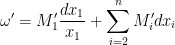
for holomorphic matrix valued functions  . Plugging this, and the expression for , into equation 1 and taking the coefficient of
  we get

Taking ( ) norms of both sides of this equation, and noting that since
  and
and  are holomorphic they are bounded in some neighbourhood of every point on the divisor, we get

for some constant  . For points away from the divisor we can write
  and we have

where  is the
  entry of the matrix
  . By the fundamental theorem of calculus we have for

and taking absolute values and using the above inequality gives

Finally, if we add up the contributions from all components of we end up with the following inequality for the norm of :

for positive constants  . We can now apply the integral form of Grönwall’s inequality to deduce that there exists a positive constant
  and a positive integer
  such that for
  small enough we have

By a version of the Riemann removable singularities theorem for many variables this implies that is meromorphic at . Hence we can write a series expansion for as follows:
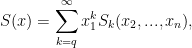
where  are holomorphic matrix-valued functions on and
  is non-zero (i.e. we take
  to be the smallest integer such that
  ). Plugging this expression for back into equation 2 and taking the coefficient of
  yields the following equation

which, upon rearranging and observing that  and
and  , becomes

If was invertible then  and
and  would be conjugate and hence have the same spectrum. At present we only know that and so we are only guaranteed that they have an eigenvalue in common. But both residues have their eigenvalues in the image of , and so this implies that
  . This shows that extends holomorphically.
 Francis Bischoff
One thought on “Deligne’s construction for extending connections.”